
The first direct detection of gravitational waves opened a completely new window on the Universe and marked the beginning of gravitational-wave astronomy. Since then, many signals from different astrophysical sources have been observed, motivating the development of the next-generation gravitational-wave detectors with significantly improved sensitivity.
The laser sources used in gravitational-wave detectors are ultra-stable systems that go far beyond commercially available lasers. They cannot be purchased off the shelf, as they must simultaneously meet extremely stringent requirements on frequency noise, power stability, spatial mode quality, long-term reliability, and high power. As a result, these lasers systems are fully custom-developed specifically for these detectors. Their design combines low-noise seed laser, high-power amplification, spatial and frequency filtering, and advanced power and frequency stabilization, making the laser itself a critical scientific instrument within the detector.
Our group, led by Walid Chaibi, plays an active role in the R&D of laser systems for future gravitational-wave detectors. Increasing the available laser power and reducing its noise is one of the key technological challenges in this effort. Below we give some information on the Virgo laser system, assembled by our group! If you are curious and want to check more information, take a look on our selected publications at the end of the page.
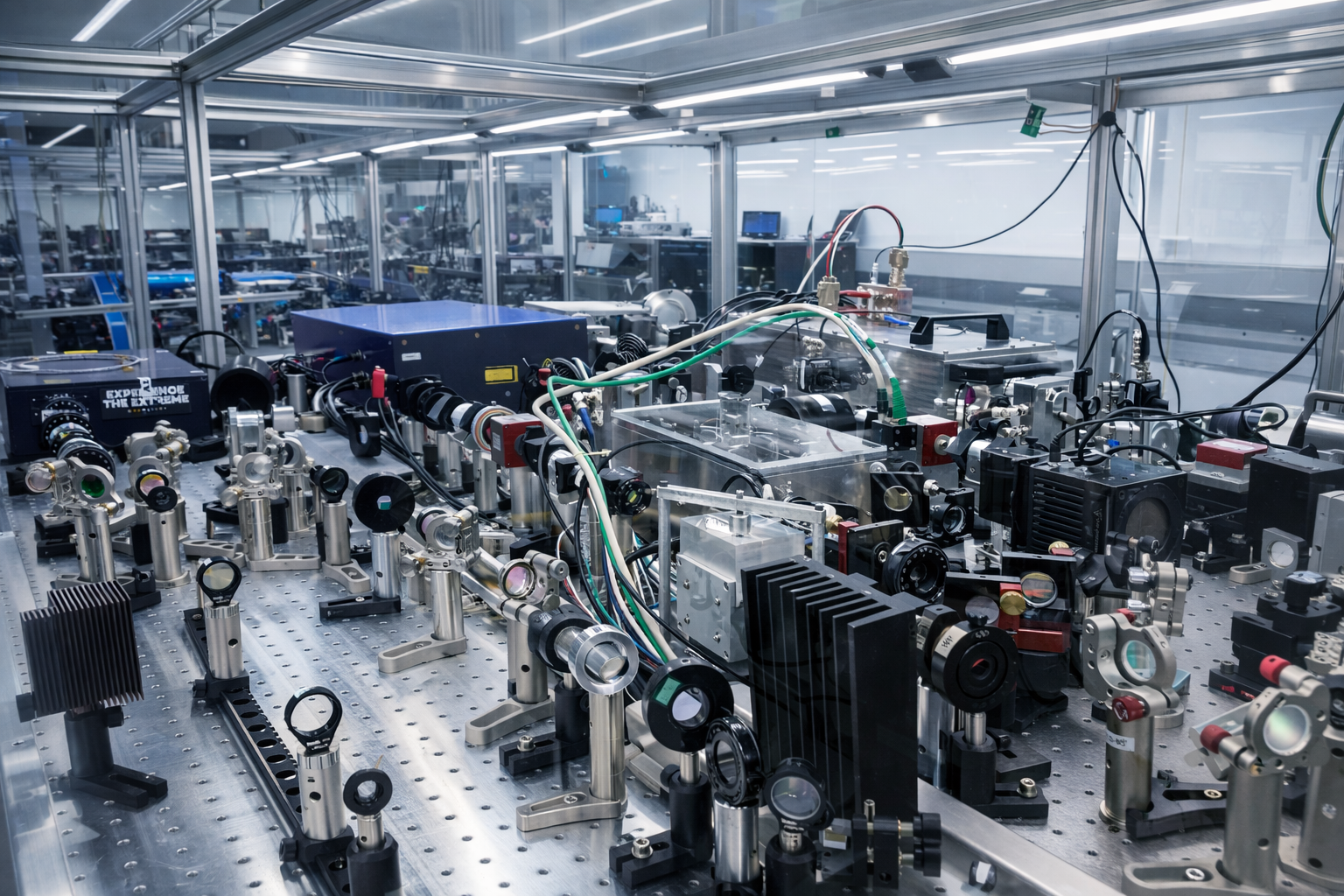
Virgo Laser Bench, credit: Walid Chaibi
The Virgo Pre-Stabilized Laser
The Virgo laser system is composed of:
- a Master Laser system which provides a single mode single frequency low power beam in the hundreds of mWatts range at 1064nm and contains different actuators to control the laser frequency on a wide frequency band
- a high power optical amplifier which brings the laser power up to tens of Watts.
- a premode cleaner cavity which filters the transverse mode of the high power beam also filters the high frequency noise of the beam
- a first stage frequency stabilization which allows afterwards a second stage frequency stabilization on the common mode of the interferometer
- a relative power stabilization at the level of a few 10−9 Hz−1/2
The laser system must meet stringent requirements set by the interferometer configuration and its target sensitivity. In particular, the amplification stage must not significantly increase the frequency noise relative to the seed laser, the output beam must remain close to a pure fundamental Gaussian mode, and beam pointing noise must be sufficiently filtered. In addition, the system must demonstrate high reliability, operating continuously over several months with limited power fluctuations and minimal long-term beam drift.